Sunday, August 18, 2013

Franz Ferdinand part 2

So the reason why I gave a short run down of the spark that ignited World War One is because I got to visit the site where the assassination took place.  A museum now stands on the corner where the archduke was shot and there is an inscription on the side of the building.  I was there back on June 29th, 99 years and 1 day after what can be argued as the most significant event of the 20th century.  There were a lot of tensions in Europe but that assassination was the spark that ignited WWI.  Then because of the treaties that ended WWI, largely punishing Germany, it allowed a climate to exist that would allow someone like Adolf Hitler to rise to power.  Then WWII ends which leads to another power struggle that would turn into the Cold War which had many peripheral wars (Korea and Vietnam to name a few) and then when the Soviet Union collapsed there were still more wars such as the Bosnian war of the 1990's.  Without the assassination would there have been a WWI and then all of the events over the next 100 years that can trace their orgins to WWI?  who knows.

anyway, her are some of the pictures that I took:


 The pants worn by Princip and the bag that he was carrying when he assassinated the archduke


Franz Ferdinand part 1

The events that lead to the outbreak of World War One are very complex.  Often it is over simplified that there were a lot of alliances between the countries of Europe and therefore when two countries went to war with each other then basically the rest of Europe would also be dragged into the war.  These alliances were forged over the decades prior to the outbreak of WWI due to other conflicts throughout Europe.  Two of the big things that lead to these alliances were imperialism and nationalism.  To keep things simple the Austria-Hungarian empire (led by archduke Franz Ferdinand) decided to annex Bosnia (Imperialism) in 1908.  Not all of the people in Bosnia wanted this.  Those who were Serbian either wanted and independent Bosnian state or to be a part of Serbia (nationalism).  Serbia supported Bosnia and threatened war and Russia agreed but then backed down so there was no war.  Then there were some other wars in the Balkan region and when it was over Austria-Hungry made Serbia give up some of its new land acquisitions.  So Serbians in Serbia and Bosnia did not like Austria-Hungry.

Then on June 28, 1914 Archduke Franz Ferdinand and his wife decided to visit the city of Sarajevo.  On their way to city hall an assassin tried to kill the archduke by throwing a bomb at his car but missed.  However, when the archduke and his wife left city hall there were more assassins waiting in the crowd.  As the archdukes car drove down the street to leave the city it stopped at one point, right in front of an awaiting assassin, 19 year old Gavrilo Princip.  Princip fired 2 shots killing the archduke and his wife (he said he wasn't trying to kill his wife).  He was captured and sentenced to 20 years in prison but died of TB a few years later in 1918.  Princip and the other conspirators were captured and gave some testimony that they were supported or received support from the Serbian Military (Princip belonged to a group known as Young Bosnians but there were other anti-Austrian groups/revolutionary groups such as The Black Hand that had been around for many years and had direct connections to the Serbian military.)  Anyway you can see how when the Austrians found out that the assassins received help from the Serbia how this could then lead the Austrians to be mad at Serbia and long story short would lead to war, but then Russia jumped in to support Serbia and then Germany jumps in to support Austria and then France jumps in against Germany so Germany attacks France and when France is attacked England jumps in and you have a world war.

Here are some pictures I pulled from the internet:

Gavrilo Princip cropped.jpgPrincip      

File:Gavrilo Princip captured in Sarajevo 1914.jpgPrincip being arrested

archduke and his wife leaving city hall


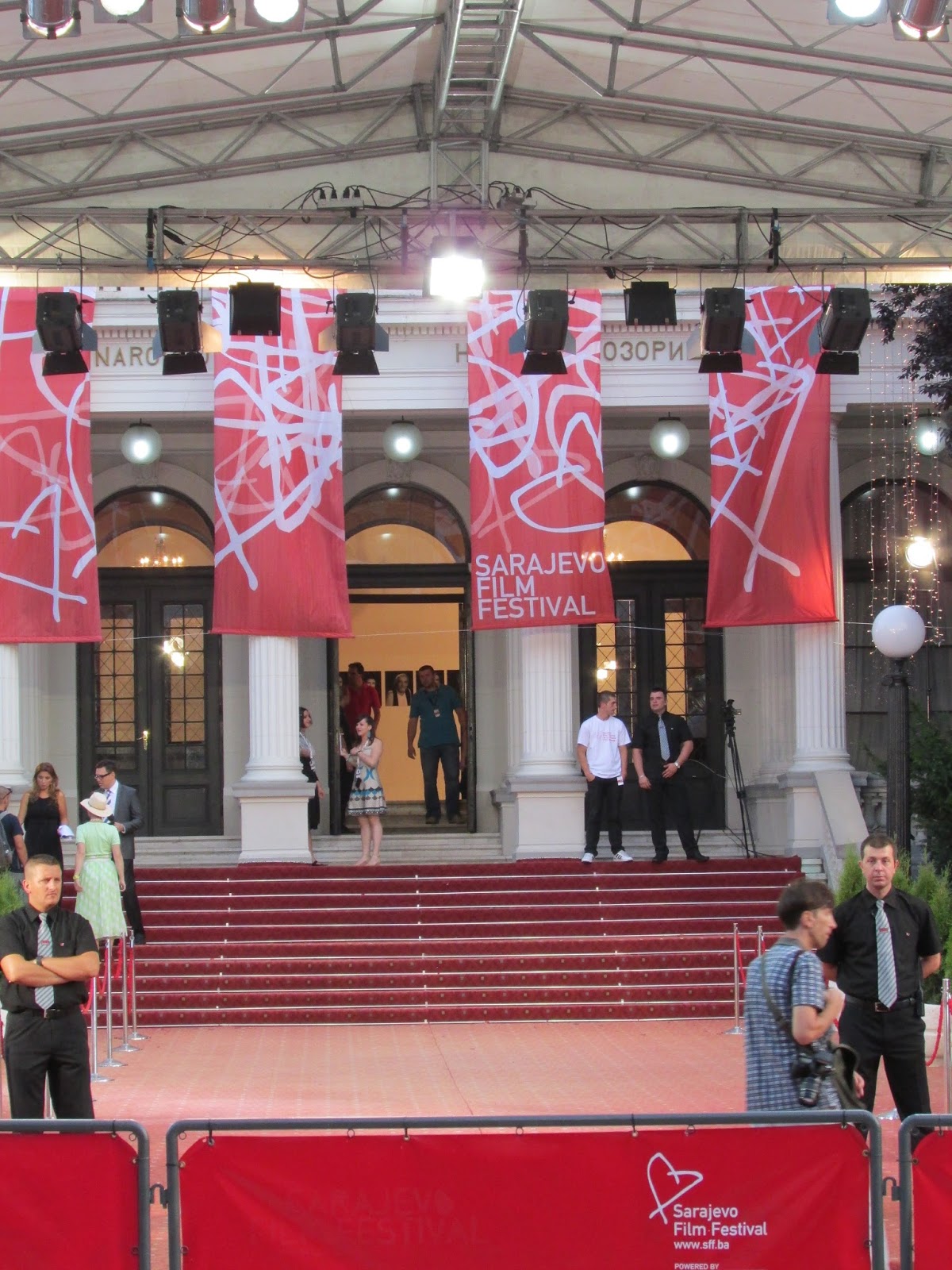
More Pictures from the Film Festival


Sarajevo Film Festival

The Sarajevo film festival started yesterday and features a number of movies made by European film makers.  I did not recognize any of the names of the films or film makers whose works will be featured at the film festival except for Woody Allen who has a new movie out.  I have seen signs around the city since I have been here advertising the film festival so I thought it might be neat to go down town to see what it was all about.  Wasn't what I had thought.  There was only one place where things were taking place.  Outside of the theater was the red carpet but when I was there it was empty.  Then there was an area with tents set up, and gated off, and all of these people in their fancy dress were going in.  I thought if I just act natural I could walk past security but then chickened out.  I don't know if the people would have a sense of humor and I don't need to get myself in trouble in a foreign country.


Saturday, August 17, 2013

A Meal at the Fanciest Restaurant in Sarajevo

So for the last week or so I have been busy, it has been hot and I haven't gone out much.  But it is a Saturday night so I decided to go downtown and go to one of the fanciest restaurants in all of Sarajevo, no, probably all of Europe.


This is probably the funniest bathroom door sign I have ever seen.  The guy looks like he is in a big hurry to take a shit after eating McDonalds


Sarajevo, a once diverse city

I am told it is estimated that more than 50% of the people who live in Sarajevo are Muslim and have heard estimates that as many as 80% may be Muslim.  I was told that this really didn't happen until after the war here back in the 1990's.  They said prior to the war the city was quiet diverse which is unique for Europe and Bosnia in general.  Some cities would be predominantly Serbian or Croatian or Muslim but usually not all 3.  Prior to the war here in Sarajevo the city was made up of Croatians who are Roman Catholic, the Serbians who are Orthodox Catholic and there were some Muslims, Jews and Chinese (the Chinese embassy is at the top of the street.  I have seen some people who are Asian but think they may have just been tourist because, like me, they were walking around with camera's.  In and around old town there are a lot of tourist mostly from around Europe.)

Anyway, I am told that after the war most Serbians moved to a district of the country called the Republica of Sperska.  The country actually has 3 districts: The Republica, The Federation and I think the third part is Herzegovina.  The country's official name is Bosnia and Herzegovina.  The country has 3 presidents one in charge of each district.  They run them sort of like a state governor would.  If they need a national policy then all 3 presidents need to agree.  I am told this doesn't often happen and so the laws vary a little bit in each district.  Each ethnic group also has their own district.  The Serbs are in charge of the Republica and then the Croats and Muslims each have a president in charge of their district (Sarajevo is a part of the Federation.)

Anyway, after the war the people became quite polarized.  I am told the Jews left and never returned, same thing with the Chinese (that is also why I think the people I have seen may have only been tourist.)  Most of the Serbs, who stayed in the city during the war and didn't leave the country after the war, moved to the Republica and the Muslims, who at the time mainly lived out in the countryside, moved into the city.  During the war the Muslims allied themselves with the Croats so there wasn't much tension between those two groups.  However, I am told there is tension between the Serbs and the other 2 groups even today.  The people I know are Serbs and say Sarajevo is probably only 2% Serbian now.  They say it with a longing for the old days.  They said that back when they were younger they had friends who were Croatian and Muslim and Jewish and everyone was fine with each other.  Then the Soviet Union collapsed and people took sides.  They still have some friends who are Muslim and Croatian but I am told most people don't interact like they used to.  There are schools that are actually segregated; Serbian only or Croatian only or Madrases which are the Muslim schools.

I have heard a number of things about life in the city prior to the war, when they were a part of Yugoslavia.  Some good and of course some bad.  The one good thing is that everyone seemed to get along.  Since it was a communist country everyone was equal.  There were some groups that were loyal to their "own kind" but am told for the most part it was a diverse city where everyone got along.  Then the war came, and went and left the people polarized.  Actually, the country has never really been a unified country.  People don't identify themselves as Bosnian.  You are either Serbian, Croatian or Muslim.  This goes back hundreds of years (first it was Serbian and/or Croatian and they would go back and forth for power and then the Ottoman's, who were Muslim came in and took over both groups and a few hundred years later left and then it was all 3 groups going back and forth), however, under the communist one group didn't dominate the others so there was some peace.  Then once the communist left it became basically a land grab.  Then to end the war they divided the country in 3 parts and gave each group a part where they could have their own president.  So rather than stay a diverse city many people took to their corners and that is where things stand today.  You don't have to live in your part of the country, however, many do because there is discrimination between who ever is the dominant group and those of the minority group.      

Are You Ready for Some Football aka Soccer

So on Tuesday I woke up and heard a few fire crackers go off.  Then all day long I kept hearing them.  Finally in the early evening I asked someone why were there constantly fire crackers being set off.  I was told the people were excited because there was going to be a football match at the stadium up the street between the US and Bosnia.  Into the early morning I heard people outside signing, I don't know what they were singing, but it was singing none the less.  I thought it was to celebrate the Bosnian's team win but I looked up the score the next day and the US actually won.  So I guess it is good that there was only singing into the early morning and not riots from European soccer hooligans.